
Yi Jun delivers keynote speech at 2025 Global Business Law Conference
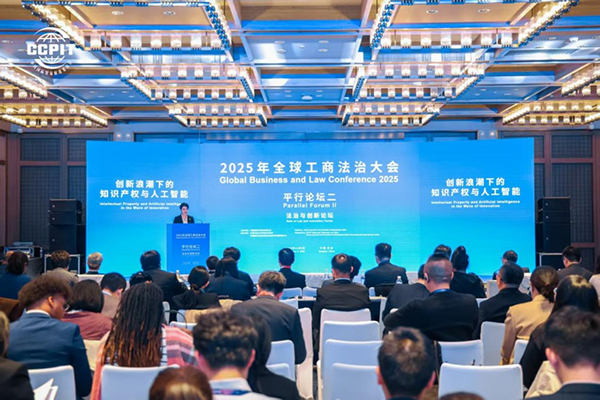
Yi Jun, vice-president of the Beijing Internet Court (BIC), was invited to attend the 2025 Global Business and Law Conference, held in Qingdao, East China's Shandong province, on Nov 5.
The conference, hosted by the China Council for the Promotion of International Trade, focused on strengthening international legal cooperation to promote inclusive economic development.
At the conference, Yi delivered a keynote speech themed "Leveraging the judicial role of intellectual property rights (IPR) to serve the high-quality development of digital economy", through which Yi introduced the BIC's overall handling of IPR cases involving artificial intelligence.

He noted that the BIC attaches great importance to the adjudication of new types of IPR dispute and strives to properly balance the relationships between innovation and incentives, development and regulation, private interests and public welfare, as well as adjudication and governance.
Focusing on the development trend of the digital economy and responding to judicial demands in IPR protection, the BIC heard a series of typical cases, including China's first copyright infringement case involving an AI-generated image, China's first unfair competition case concerning the evidentiary effect of the IPR Registration Certificate, and a copyright infringement case involving virtual digitalized human images. These cases have filled gaps, established rules and provided leading and exemplary reference for judicial practice, according to him.

Looking ahead, Yi said that in the face of new challenges and opportunities brought by emerging technologies such as artificial intelligence in the context of the digital economy, the BIC will accurately identify the key areas where it can serve the overall development, he said.
More efforts will be made to proper handling of new types of internet-related cases, so as to provide more precise, efficient and strong judicial services and safeguards for empowering innovation through IPR protection and building an open, inclusive, fair and orderly environment for digital economy development.
 Judicial White Paper
 Play
Play Play
Play Online Lawsuit Guide
 Beijing Internet Court Lawsuit Service WeChat Account
  Beijing Internet Court WeChat Account


